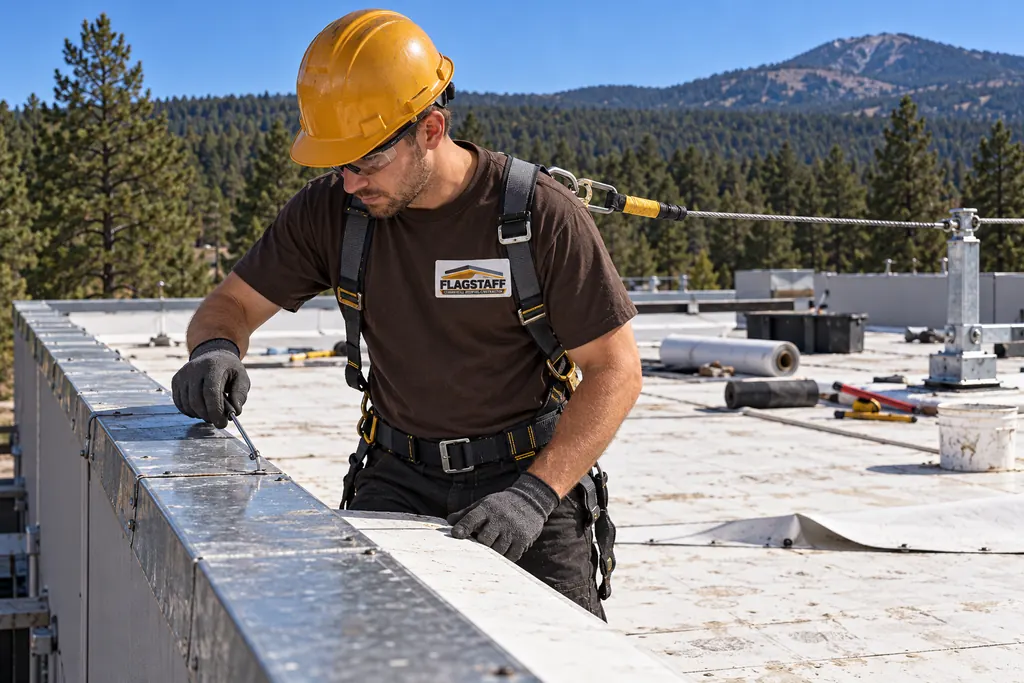
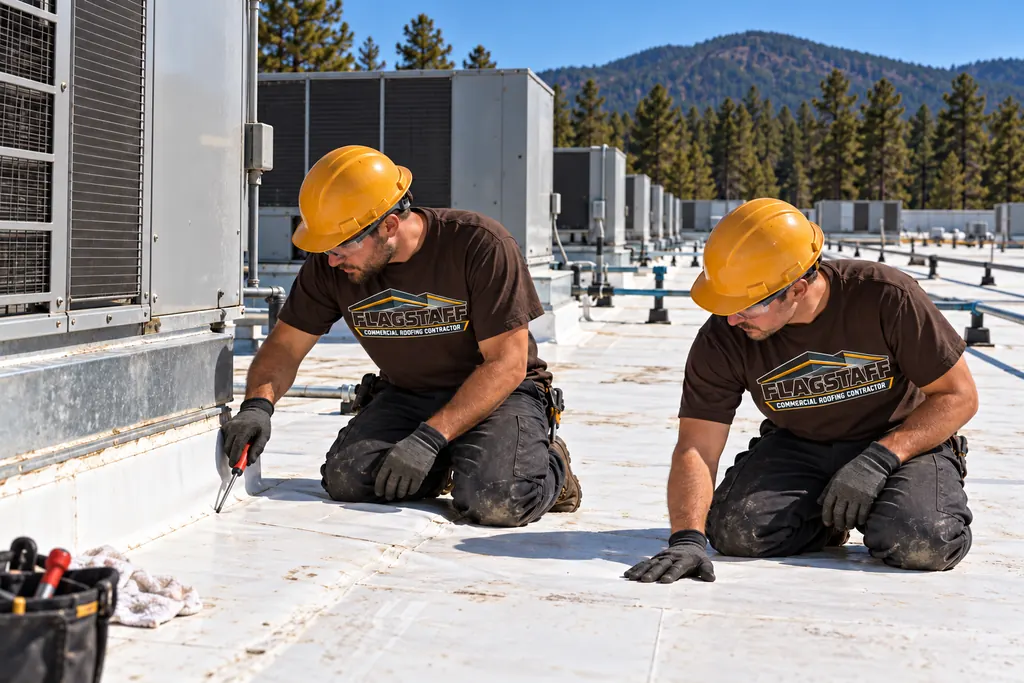
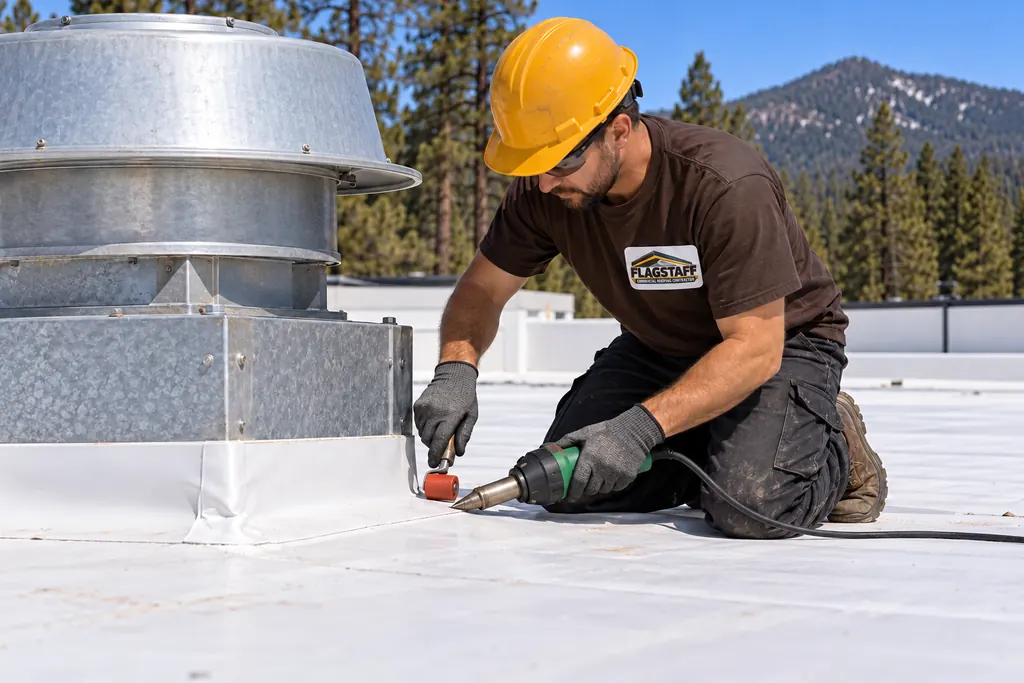
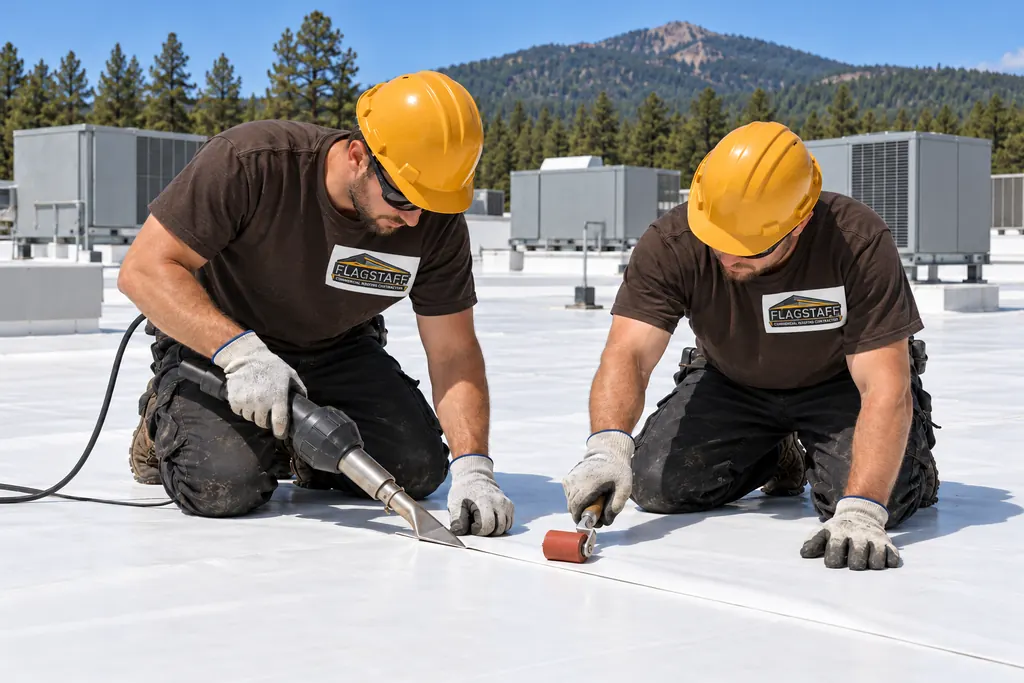
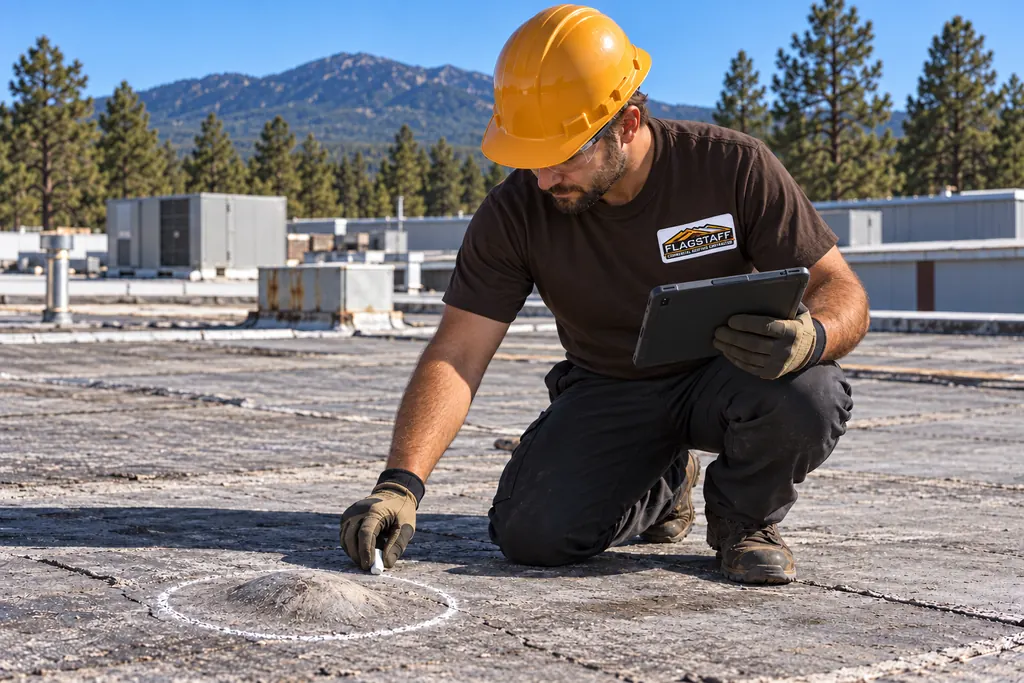
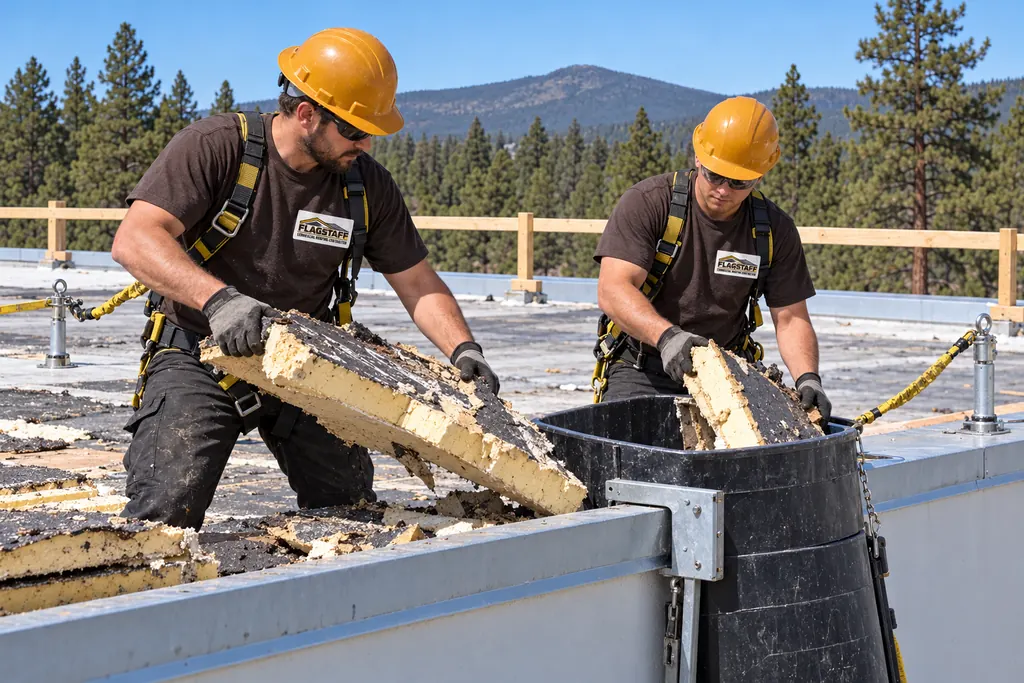
As a Bellemont commercial roofing contractor, we replace, repair, and install roofs on warehouses, distribution buildings, and plants along I-40. Every job starts with a roof inspection.
Bellemont sits on I-40 about 10 miles west of Flagstaff, and the National Weather Service runs its Flagstaff forecast office from Camp Navajo here. The commercial roofs along this stretch are mostly wide and low: warehouses, distribution buildings, and plants with long spans and few roof drains.
On a roof that size, meltwater has a long way to travel. We look first at how water reaches each drain after a thaw, then at the curbs, fans, and joints that dock and service traffic wear down.
Ponding between drains after snowmelt
Punctures near exhaust fans and HVAC curbs
Expansion joints that open as long sections move in the cold
Work phased so loading docks stay open
Leak Signs
Warehouse Leaks Traced Back To The Roof
Most calls start with something a manager sees inside. Here is how common Bellemont warehouse symptoms line up with what we find above them.
Inside The BuildingOn The Roof
Inside
Drips Over The Racking
Water lands on pallets mid-aisle, often days after a snowfall and far from any wall.
On the roof
Ponding Between Drains
Meltwater sitting in a low spot between two drains finds a weak lap. We map the low areas and correct them with tapered insulation or an added drain.
Inside
A Ring Under A Fan
Ceiling tiles or the deck show a stained ring under an exhaust fan or rooftop unit.
On the roof
Punctures At Curbs
Service techs walk the same path to every unit. Dropped tools and boot traffic cut the membrane near curbs, so walkway pads belong along those paths.
Inside
Wet Floor At The Docks
Puddles form along the dock doors after a thaw, with nothing dripping from overhead.
On the roof
Wall And Edge Flashing
Ice at the roof edge backs water under the wall flashing above the docks. We reflash the wall and check the coping and edge metal.
Inside
Rust On The Steel Deck
Orange spots or flaking show up on the underside of the metal deck between joists.
On the roof
Wet Insulation
Water that has been getting in for a while soaks the insulation boards. A moisture survey shows how much is wet before anyone prices a recover.
Inside
A Gap That Grows In Winter
A ceiling seam or wall joint opens in the cold months and closes again by summer.
On the roof
Expansion Joint Leaks
Long building sections shrink in the cold and pull on the expansion joint cover. We replace the cover and flash it into the membrane.
Who Gains
Gains From A New Roof In Bellemont
A new roof on a Bellemont warehouse pays back in fewer leaks, steadier operations, and drier work floors for everyone tied to the building.
Owner
Wide TPO sheets cover a big warehouse roof with fewer laps, so the building has fewer places where a leak can start.
Replacing wet insulation boards restores the roof's insulating value and keeps the deck from carrying the weight of soaked material through winter.
Facility Manager
Tapered insulation slopes every section toward a drain, so meltwater leaves the membrane quickly and stops pooling around the outlets.
Walkway pads from the roof hatch to each rooftop unit keep service techs on a marked path and off the field membrane.
Edge metal and coping fastened tight to the wall hold through summer storm gusts, which cuts the emergency calls after a windy night.
Tenants And Staff
Dock and floor areas stay dry once welded seams and new curb flashings stop the drips that used to land on stored goods.
Warmer air stays inside the building once new insulation goes over the deck, keeping work areas comfortable through long cold mornings.
Roof Systems
Roof Systems We Install In Bellemont
Two systems cover most of the large low-slope buildings here. The choice turns on rooftop equipment, traffic, and how the building is used.
Plants and distribution buildings with heavy equipment, exhaust stacks, and daily service traffic. We phase the roof by section so docks and shifts keep running.
Big roofs get done in sections, with each one closed before the weather turns. Here is the order we follow.
1
Inspect Your Roof
We walk the full roof and the floor below it, marking ponding, punctures, and open laps. Infrared scans or core samples show where the insulation is wet.
2
Plan The Sections
Each roof section is sized so it can be torn off and closed by the end of that day. Dock bays, fire lanes, and crane spots go on the plan before work starts.
3
Open One Section At A Time
Crews remove wet insulation, repair deck damage, and set tapered boards toward the drains. Open areas are sealed before afternoon storms or evening cold.
4
Weld, Flash, And Walk It
Laps are welded and probed, curbs and walls flashed, and walkway pads set to each unit. Last comes a walk with you to check every drain.
Straight answers to what owners and facility managers ask before a roof job on a Bellemont building.
Can the warehouse stay open while the roof is replaced?
Yes, in most cases. We open one section at a time and make each one watertight before the end of the day.
Noisy tear-off can run early or on off days, and materials and cranes are staged away from entrances, dock bays, and fire lanes. HVAC intakes get covered against dust and fumes, and we coordinate timing with your tenants or shift leads.
Who issues roofing permits for a Bellemont property?
Coconino County Building and Safety, since Bellemont is unincorporated county land.
For commercial work, the county asks for a pre-construction meeting with building staff before the application goes in. We confirm the current requirements with the county for your parcel before any work starts.
How do you find the wet areas on a large roof?
We combine a walk-through with a moisture survey. Infrared scanning on a cool evening shows wet insulation as warmer patches, and core samples confirm what the scan suggests.
The result is a marked roof plan showing dry areas, wet areas, and the details that let the water in.
Can a new roof go over the existing one?
Sometimes. A recover needs dry insulation underneath, a deck in good shape, and room under the code for another layer.
Weight matters here too. Coconino County sets ground snow loads by parcel, and adding a layer adds load, so we check that before recommending a recover over a tear-off.
Why does the membrane keep failing around rooftop units?
Foot traffic is the usual cause. Technicians cross the same route to every unit, and dropped tools, ladders, and boots cut or scuff the membrane along that line.
Walkway pads on those routes, plus reflashed curbs with enough height above the roof, stop most of the repeat repairs.
What if the roof only has a few drains for a big area?
Tapered insulation is the first fix. It builds slope toward the existing drains so water stops collecting in the middle of the bays.
Where the distance is too long, crickets between drains or an added drain or scupper shorten the path. We size that during the inspection.
How long does a warehouse roof replacement take?
It depends on the roof area, how much insulation is wet, and the weather window. A large roof is done in daily sections, so the building stays covered the whole time.
Late spring through early fall gives the most working days at this elevation, so planning ahead helps lock in a spot in that window.
Next Step
Talk To A Bellemont Commercial Roofing Contractor
Tell us the roof size, the bays that leak, and when the docks are busiest. We will set up the inspection around them.