Owner
- Tapered insulation and added drains or crickets carry meltwater across long bays instead of leaving it to pond between drains.
- Thicker, reinforced membrane stands up to daily service visits and lasts longer under rooftop equipment.

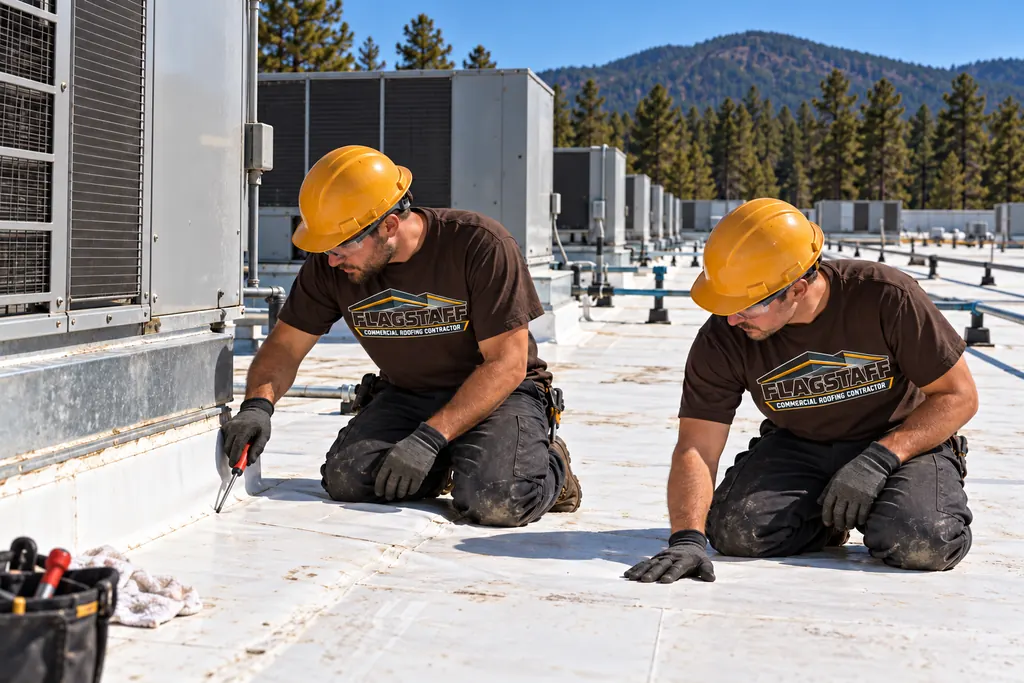
Plants And Warehouses
We replace and repair roofs on Flagstaff plants, warehouses, and distribution buildings. As an industrial roofing contractor, we phase each job so docks and production keep running.
Is It A Fit
Industrial roofs differ from other commercial roofs in size, equipment, and how closely the work has to fit around operations.
Leak Signs
Industrial leaks rarely drip straight down. Here is how floor-level signs connect to the roof details behind them.
Drips land on equipment or a line after snowmelt, sometimes well away from the opening.
Heat and vibration from exhaust fans break down curb flashings. We reflash with taller curbs and details chosen for the exhaust.
Vinyl-faced insulation under the deck shows brown streaks along a joist line.
Water enters at one detail and spreads through the insulation. Infrared and core cuts map the wet area before repairs start.
Water runs down the inside wall at a dock door or overhead door.
Freeze-thaw cracks the sealant at wall flashings and coping joints above the doors. New flashing and coping close the wall.
Long ceiling seams open in the cold months where building sections meet.
Long sections move in the cold and stretch the joint cover. A new expansion joint cover is flashed into the membrane on both sides.
Leaks follow the path technicians walk across the roof to reach the units.
Dropped tools and boots cut the membrane along service routes. Walkway pads and a thicker membrane protect those paths.
Your Options
Large roofs rarely need one answer everywhere. Sections of the same building are often repaired, recovered, and replaced.
| Option | What it involves | When it fits |
|---|---|---|
| Section repairs | Rebuilt curbs, rewelded laps, and new walkway pads on worn routes | Most of the roof is dry and failures sit at details |
| Phased replacement | Roof replaced section by section over one or more seasons | Wet insulation is spread out and the budget or schedule calls for phases |
| Recover with tapered insulation | New tapered boards and membrane over a dry existing roof | Ponding between drains on dry insulation, where the snow load allows the weight |
| Metal retrofit | Framing and metal panels over the existing low-slope roof | The structure can carry the framing and the building needs slope |
Who Gains
On a plant or warehouse, a new roof is judged by how well it keeps operations dry and running. Here is who gains.
Roof Trouble
Call and tell us where the water lands and what equipment sits above it. We will start the inspection at those curbs and drains.
How The Work Runs
Industrial jobs follow the same order as any roof, with more planning around the floor below.

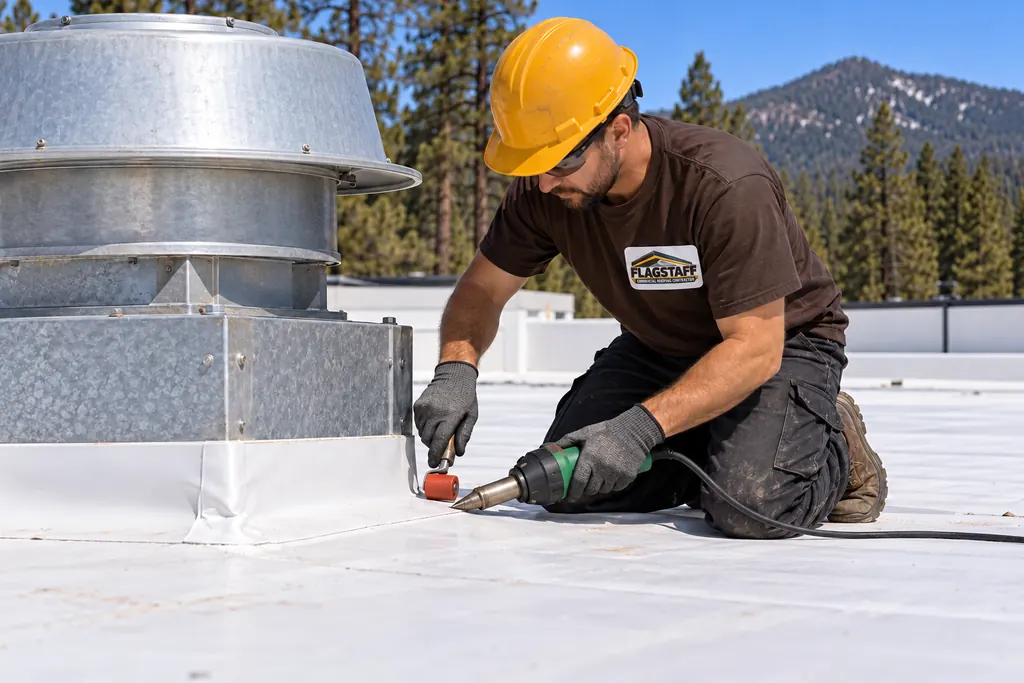
We map the whole roof: drains, curbs, joints, walkway routes, and wet areas found by infrared or core cuts. The floor plan below goes on the same map.
Roof sections are matched to shift changes, shipping days, and shutdowns. Crane spots, material drops, and fire lanes are agreed before work starts.
Each roof section is torn off, dried in, and closed before the end of the day. Intakes near the work are covered against dust and fumes.
Curbs, joints, and walls are flashed, walkway pads set, and drains tested. The roof plan you keep shows every repair and new detail.
Roof Systems
Big buildings often mix systems, with a membrane on the main roof and another system on wings or problem areas.
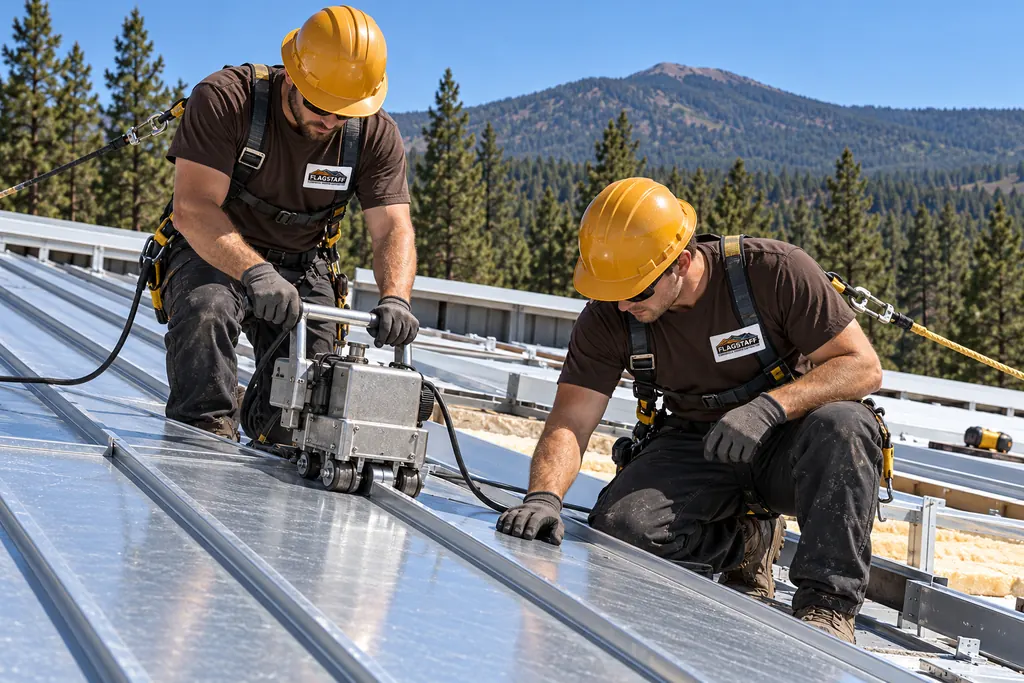
Buildings that need slope across a wide flat roof can take metal retrofit framing and panels after a structural check.
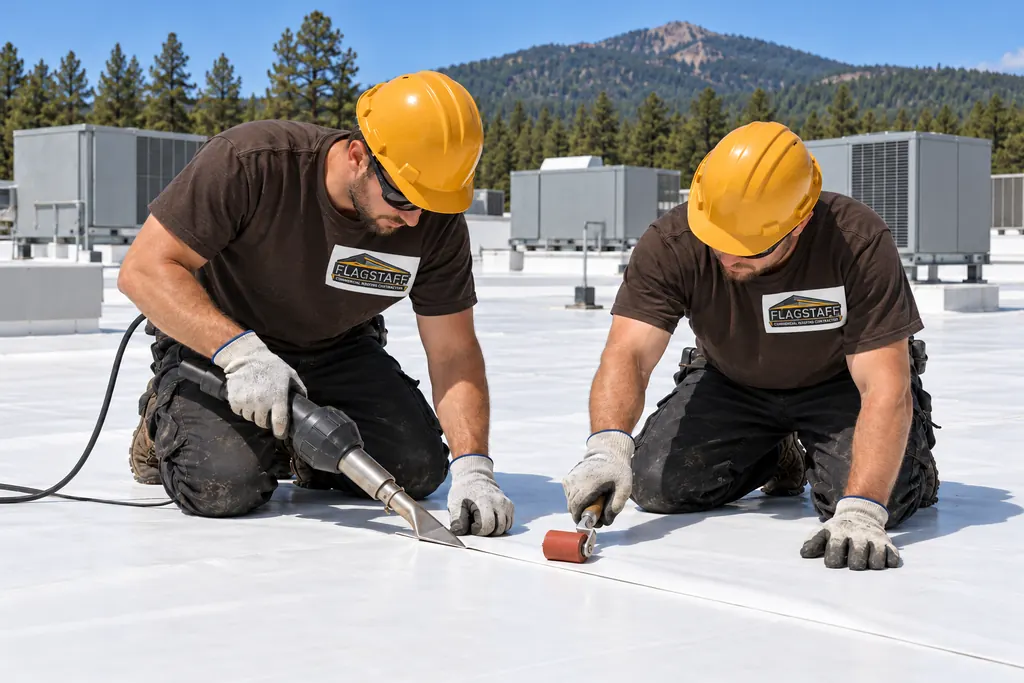
Warehouses with wide low-slope bays get white TPO in wide sheets, with every weld probed before a section closes.
Common Questions
Questions plant managers and warehouse owners ask before work starts on a large roof.
Drainage that keeps up with snowmelt, a membrane or panels that tolerate rooftop equipment, and a work plan that keeps loading docks moving.
Plants and distribution buildings west of Flagstaff and along I-40 often have wide spans with few drains. The trouble spots we see most are ponding between drains after a thaw, punctures by exhaust fans and HVAC curbs from service traffic, and expansion joints leaking where long sections move in the cold.
Yes. Large roofs are often split into phases by section, with the wettest areas done first.
Each phase is closed and watertight on its own, and the remaining sections get repairs to carry them until their turn comes.
Each open section is kept small enough to close before the end of the day, and air intakes near the work are covered.
Where the deck is open above product or equipment, we set protection below with your facility staff and schedule that section for a quiet shift.
Lifelines, anchors, and warning lines at the edges, set up before work starts on each section.
Permanent anchors can be added during a replacement so later service visits have tie-off points, which is worth planning on a roof with many units.
Heat, vibration, and residue from exhaust fans break down sealants and membrane at the curb.
Some exhaust also softens or stains certain membranes, so the membrane and flashing at those curbs get chosen for the exposure, and the curbs go on the spring and fall inspection list.
Yes. Pipe supports, conduit runs, and equipment rails all get flashed or set on supports that protect the membrane.
Any lifting, lockout, or disconnect is coordinated with your maintenance staff before that section opens.
By never opening more than can be closed quickly. Each section gets a temporary seal at its edge as work moves along.
In monsoon season, which runs June 15 through September 30, we start early and close the day's section before the afternoon storms build.
Next Step
Tell us the building's size, shift schedule, and where water reaches the floor. We will plan the inspection around production.
Leave a name and number and we will call you about the roof.
Or call now: (928) 430-5703