Commercial Roofing FAQ

Flagstaff Commercial Roofing FAQ

Flagstaff sits at roughly 7,000 feet, where commercial roofs carry heavy snow for months, cycle through freezing nights and sunny afternoons, and take hard summer storms.

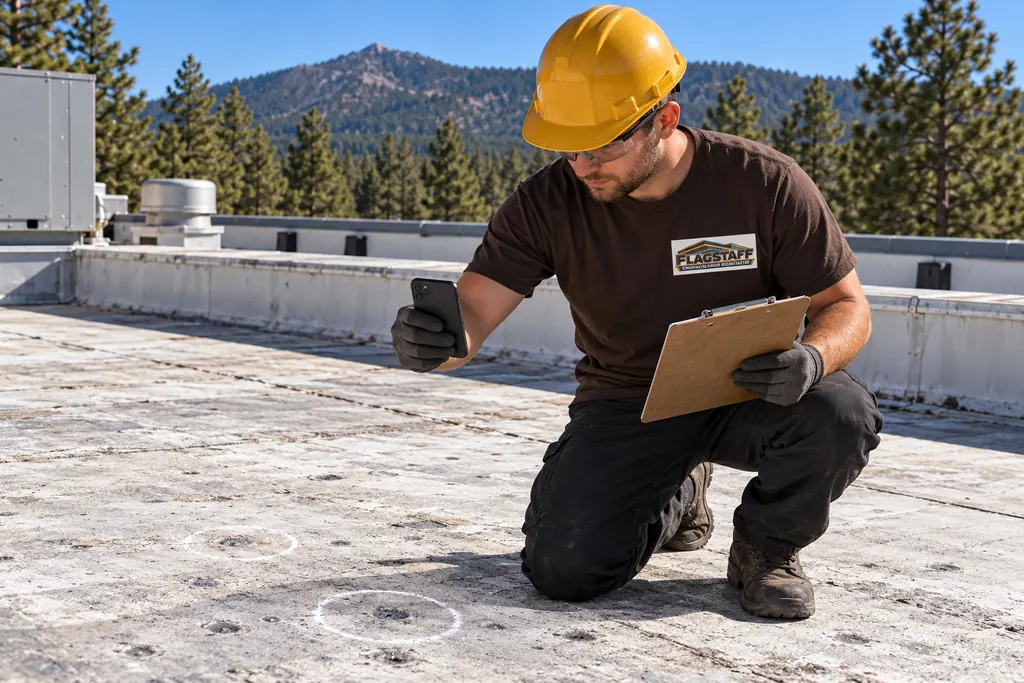
Roofer photographing hail bruises on a roof membrane while holding a clipboard

About These Answers

A Flagstaff Commercial Roofing FAQ Built Around Snow

Warehouses near the interstate, downtown masonry storefronts, medical offices, schools, and hotels each put different demands on a roof.

We install and maintain TPO, EPDM, industrial, and metal roof systems built for that mountain climate.

Owner FAQ

Roof Systems And Building Types

What does a Flagstaff commercial roofing contractor actually do?

We inspect, repair, and replace roofs on commercial and industrial buildings, including TPO, EPDM, and metal systems. The work ranges from sealing a single failed seam to tearing off and rebuilding a full roof assembly.

In Flagstaff, much of that work centers on snow: checking that drains and scuppers stay open, that flashings survive freeze-thaw, and that the deck and insulation underneath stay dry through a long winter.

Is a TPO roof a good fit for flat commercial roofs in Flagstaff?

Yes, for many low-slope buildings. TPO is a single-ply membrane with heat-welded seams, which hold up well against standing meltwater when they are welded and probed correctly.

At this elevation, the details matter more than the membrane. We pay close attention to:

  • Seam welds at laps, corners, and penetrations, where meltwater sits longest.
  • Insulation thickness under the membrane, since cold-weather heat loss drives melt and refreeze at the edges.
  • Drain placement relative to where snow drifts against parapets and rooftop units.

White TPO also reflects summer sun, which helps buildings with large cooling loads in July and August.

When does EPDM make more sense than TPO in a cold mountain climate?

EPDM stays flexible in deep cold, so it is a strong choice where roofs see many hard freezes and heavy foot traffic is rare. Black EPDM also absorbs winter sun, which can help snow clear sooner on some roofs.

TPO is often preferred where summer cooling costs dominate or where heat-welded seams are wanted. We compare the existing assembly, deck type, drainage, and how the building is heated before recommending one over the other.

What do industrial and warehouse roofs in the Flagstaff area need?

Large industrial roofs need drainage that keeps up with snowmelt, membranes or panels that tolerate rooftop equipment, and a work plan that keeps loading docks moving.

Warehouses, distribution buildings, and plants west of Flagstaff and along the I-40 corridor often have wide spans with few drains. Common trouble spots include:

  • Ponding between roof drains after a thaw.
  • Punctures near exhaust fans and HVAC curbs from service traffic.
  • Expansion joint leaks where long building sections move in the cold.

Why choose a metal roof for a commercial building in Flagstaff?

Metal sheds snow well on sloped roofs, resists wind, and can last for decades with care. Standing-seam panels are common on retail, offices, shops, and newer buildings with pitched roof sections.

Snow sliding off metal is the main design concern. Snow guards, eave placement over entrances and walkways, and secure fastening at the panel ends keep sliding snow from damaging gutters, vehicles, or people below. Retrofit metal over an existing low-slope roof is also possible on some buildings after a structural check.

Which roof system fits my type of building?

The right system depends on roof slope, structure, rooftop equipment, and how the space below is used. Common starting points we see around Flagstaff:

Building typeCommon starting pointWhy it often fits
Warehouse or distribution centerTPO or metalLarge spans, reflective surface, fewer seams with wide sheets or long panels
Manufacturing or industrial plantTPO, EPDM, or metalTolerates equipment, exhaust, and service traffic with proper walkway pads
Retail strip or shopping centerTPOLow-slope roofs with many rooftop units and tenant penetrations
Downtown masonry storefrontEPDM or TPOSmall, parapet-walled roofs with tight access and older decks
Office, medical, or school buildingTPO, EPDM, or metalVaries with slope, insulation needs, and occupancy schedules
Hotel or lodgingTPO or metalMix of flat and pitched sections, guests below year-round

No rule of thumb replaces an inspection. Deck condition, existing layers, and structural capacity for snow can change the answer.

How long do TPO, EPDM, and metal roofs last in Flagstaff?

Common ranges are roughly 20 to 30 years for TPO, 25 to 30 years for EPDM, and 40 years or more for metal. Actual life varies with installation quality, membrane thickness, drainage, and maintenance.

SystemTypical service lifeWhat shortens it here
TPOAbout 20–30 yearsPoor seam welds, ponding, rooftop traffic
EPDMAbout 25–30 yearsSeam adhesive failure, punctures, edge uplift
Metal40+ yearsLoose fasteners, corrosion at cut edges, sliding-snow damage

Heavy snow and long winters reward a roof that drains well and gets checked every spring and fall.

Owner FAQ

Snow, Weather, And Roof Condition

How does Flagstaff weather wear down a commercial roof?

Snow weight, freeze-thaw cycling, intense high-altitude sun, and summer storms all work on a roof here. Most leaks we find start where these forces meet a seam, drain, or flashing.

ConditionWhat it does to the roofWhat we check
Heavy, lingering snowAdds structural load; drifts pile against parapets and unitsDeck deflection, drift zones, drain access
Freeze-thaw cyclesWater in cracks expands and opens seams and flashingsPerimeter metal, sealant joints, curb flashings
Ice dams at edgesMeltwater refreezes at cold eaves and backs upEave details, gutters, insulation at the edge
Strong UV at altitudeDries out coatings, sealants, and exposed membraneSurface chalking, cracking, brittle laps
Summer thunderstormsShort bursts of heavy rain, wind, and sometimes hailDrain capacity, loose edges, impact marks

The National Weather Service defines Arizona's monsoon season as June 15 through September 30, and the Flagstaff forecast office covers northern Arizona. A pre-monsoon drain check pays off.

How much snow load does a commercial roof in the Flagstaff area need to handle?

It depends on the exact parcel, since design snow loads climb with elevation. Your local building department sets the criteria, and an engineer confirms them for structural work.

Coconino County asks designers to use a parcel-specific ground snow load from its snow load study or the ASCE Hazard Tool. It also requires engineered plans where ground snow loads exceed 70 psf. Adding a new layer or heavier system can change the load, so we flag that before any recover.

Why do ice dams form on commercial roofs here, and how are they stopped?

Ice dams form when heat escaping through the roof melts snow, and that water refreezes at a colder edge. The ice then backs water up under laps and flashings.

The lasting fixes address the cause:

  • Insulation upgrades that cut heat loss through the deck.
  • Air sealing at roof penetrations and wall-to-roof joints.
  • Edge and gutter details that let meltwater leave before it freezes.
  • Ice-barrier underlayment at eaves on sloped sections.

Chipping ice off a membrane often causes more damage than the dam itself.

Should I repair or replace my commercial roof?

Repair makes sense when damage is limited and the insulation underneath is dry. Replacement is usually the better path when wet insulation is widespread, leaks keep returning, or the system is near the end of its service life.

Usually a repairUsually a replacement
A few open seams or puncturesSaturated insulation over large areas
Damaged flashing at one unit or wallMembrane shrinking or pulling from the perimeter
Clogged or broken drainsRusted-through metal panels or deck
Small ponding spotsRepeated leaks after repeated repairs

A moisture survey often settles the question. Infrared or core samples show how much of the roof is still dry.

What maintenance keeps a commercial roof healthy through Flagstaff winters?

Two inspections a year, in spring and fall, plus a check after major storms. Fall work gets the roof ready for snow; spring work finds what winter opened up.

SeasonFocus
FallClear drains, scuppers, and gutters; reseal flashings; confirm snow guards are secure
After big snowsWatch for ponding, sagging, or blocked drains; avoid metal shovels on membranes
SpringLook for freeze-thaw damage, open seams, and edge uplift
Before monsoonRetest drain flow and secure loose edge metal

Keeping a simple log of leaks and repairs helps spot patterns early.

Owner FAQ

Planning The Roof Work

When is the best time of year to replace a commercial roof in Flagstaff?

Late spring through early fall is the main window, since many membranes, adhesives, and sealants need warmer, dry conditions. That season is short at this elevation, so planning ahead matters.

Summer afternoons bring storms, so crews often start early and close in each section before the weather turns. Emergency repairs happen year-round, including temporary dry-ins during winter.

Can you work on our roof without shutting down the business?

In most cases, yes. We phase roof work so that only one section is open at a time and each section is watertight by day's end.

Typical steps to limit disruption include:

  • Scheduling noisy tear-off for early hours or off days.
  • Staging materials and cranes away from entrances, docks, and fire lanes.
  • Protecting HVAC intakes from fumes and dust.
  • Coordinating with tenants, guests, or patients about timing.

How do I get started?

Call us or request a free estimate to set up a commercial roof inspection. We walk the roof and the interior below it to understand the full picture.

The inspection checks:

  • Membrane or panel condition, including seams, laps, and fasteners.
  • Flashings at walls, curbs, vents, and edges.
  • Drainage through drains, scuppers, and gutters.
  • Moisture in the insulation and deck.
  • Snow and ice risk areas such as drift zones and cold eaves.
  • Interior signs like stains, rust, or sagging ceiling tiles.

You get a clear explanation of what we found and whether repair, recover, or replacement fits the building.

Owner FAQ

Permits, Taxes, And Incentives

Do I need a permit to reroof a commercial building in Flagstaff or nearby areas?

Plan on it. Flagstaff's city code treats commercial reroofing as permitted work, and Coconino County and the City of Williams require permits for construction in their jurisdictions.

Which office issues the permit depends on whether the property is inside a city or in unincorporated Coconino County. The County's parcel viewer shows the district for any address.

LocationPermitting authorityNotes
FlagstaffCity of FlagstaffCity code lists over-the-counter re-roofing permits, valid up to 180 days
WilliamsCity of Williams Building DepartmentIncorporated city; permit applications include a roof plan
BellemontCoconino County Building and SafetyUnincorporated county
Doney ParkCoconino County Building and SafetyUnincorporated county
Kachina VillageCoconino County Building and SafetyUnincorporated county
MountainaireCoconino County Building and SafetyUnincorporated county
Munds ParkCoconino County Building and SafetyUnincorporated county
ParksCoconino County Building and SafetyUnincorporated county

For county commercial work, Coconino County asks for a pre-construction meeting with building staff before application. Requirements change, so confirm with the authority before work starts.

Does historic review affect roof work in Williams or downtown Flagstaff?

It can in Williams. The City of Williams lists a historic preservation approval among its building permit forms, so roof changes on older downtown buildings may need that step.

Flagstaff's downtown also has many historic masonry buildings. Before changing roof materials, edge metal, or anything visible from the street there, check with the City of Flagstaff on whether historic review applies to that property.

Can a new commercial roof qualify for Section 179 expensing?

Often, yes. Under IRS rules, roofs count as qualified Section 179 real property when they improve an existing nonresidential building after it was first placed in service.

For tax years beginning in 2026, the maximum Section 179 deduction is $2,560,000, with a phase-out starting once qualifying purchases pass $4,090,000, per IRS Publication 946. A few limits to keep in mind:

  • Residential rental buildings fall outside the nonresidential roof category.
  • Timing matters, since the roof must be placed in service in the tax year claimed.
  • Your CPA should confirm eligibility and how it fits with depreciation.

Are there utility programs or incentives for a reflective commercial roof?

Sometimes. Much of the Flagstaff area is served by Arizona Public Service (APS), and utilities periodically offer business energy-efficiency programs. Check your bill to confirm your provider.

Programs change often and funding can run out, so we never count on a rebate when planning a roof. Where a reflective-roof program does exist, it typically requires a product rated by the Cool Roof Rating Council. Confirm current terms directly with your utility before the work begins.

Owner FAQ

Service Areas

Next Step

Still Have A Roof Question?

Call with the building type and what you are seeing, or request an estimate and we will set up an inspection.

Call Us (928) 430-5703